



A nightmarish parable
Édouard Lalo’s opera „Fiesque” after Schiller finally makes it to the stage
Édouard Lalo’s opera Fiesque had to wait 140 years before it was performed in a concert version in Montpellier in 2006, and then was finally premiered on stage at the National Theatre Mannheim on 16 June 2007. Falling between a number opera and a through-composed piece, the work has qualities which make it interesting today, as Jens-Daniel Herzog’s Mannheim production showed.
A hero with political explosiveness
Lalo submitted the score of Fiesque for a composition competition at the Théâtre Lyrique, Paris, in 1867, but was unsuccessful. After attempting in vain to have the opera premiered at the opera in Paris and Brussels, he had the vocal score printed at his own cost in 1872. Later he borrowed from the music for other works, particularly for his Symphony in G minor (1886).
What may have induced Lalo, one of the leading 19th century French composers of instrumental music alongside César Franck and Camille Saint-Saëns, to set Schiller’s republican tragedy Die Verschwörung des Fiesco zu Genua? The young Schiller’s play, written between Räuber and Kabale und Liebe, is seldom performed and, even amongst Schiller scholars, has received little attention. At the centre of the plot set in 1547 in Genoa is the young Count Fiesco, who as leader of a conspiracy overthrows the Doria regime, but in the same night as the successful putsch, perishes through an unhappy accident. Schiller’s version, which treats the historical story freely, makes Fiesco into a psychologically complex, but nonetheless political hero who manipulates the republican conspiracy in order to succeed the overthrown Doria as sole ruler; thereupon he is drowned by his co-conspirator Verrina. The plot, ”a drama about a great hero who evokes no empathy” (according to the literary scholar Nikola Rossbach), had a certain explosiveness in the France of the Second Empire for its analogy with the political career of Napoleon III.
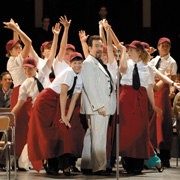
In their adaptation of Schiller’s original, Lalo and his librettist Charles Beauquier not only shortened it, but at the same time, considerably altered the drama. On the one hand, they assigned the chorus a major role, thus bringing the people into the drama as major players in the action. On the other hand, Fiesque, portrayed by Schiller as wavering between politics and instinct, is shown as a pure opportunist and playboy lacking in principles. Fiesque, according to Jens-Daniel Herzog, the director of the Mannheim premiere, ”doesn’t represent a political idealist, he is an actor above all dependent on making a perfect performance.”
Both alterations owe something to the musico-dramatic form of grand opera, which was already in its last stages by this time, as seen in works such as Giacomo Meyerbeer’s L’Africaine (1865) and Giuseppe Verdi’s Don Carlos (1867), composed for Paris. Fiesque, a weakling, a victim of his egoisms, presents a negative view of humanity – Lalo’s music, above all, with its dominating characteristic of lyricism accentuates this aspect and is decisively influenced by the dramaturgical paradigm change of the ”psychic irrational character” (Jürgen Schläder). Lalo had found this in Charles Gounod’s Faust (1859), a most popular in the 1860s, and it was further developed by Massenet above all during the two following decades.
A work of decline/downfall
A glance at the score shows that whilst holding strong to the traditional inward-looking forms with its distinctive rhythms and recurring motives, Lalo’s music at the same time reveals a strong tendency to through-composition. The major figures – next to the title role, the two women Léonore and Julie, the principled republican Verrina and the moor Hassan – who acts in the opera as a hard-bitten businessman as the ”merchant of death” (Herzog) – are musically well-defined; though they are scarcely rippling with effective melody, which is probably the reason for the lack of interest at the time in Lalo’s setting of the work.
Lalo did, however, write a sumptuous large orchestral score, far exceeding the work of his contemporaries Gounod or Ambroise Thomas. The harmony also reveals that as an instrumental composer, Lalo had studied German chamber music in detail and even at this early date, he was familiar with the mid-period works of Wagner. In an essay included in the Mannheim programme, Jürgen Schläder has rightly emphasised that the orchestra does not approach the function of a psychological mediator or commentator of the glaring contradictions in Fiesque’s character: “The intentions of the theatrical figure and its musical profile fall apart.”
Uwe Schweikert
(translation: Elizabeth Robinson)
(aus takte 2/2007 – photos: Hans Jörg Michel)