



After the great success of “Superorganisms” in Tokyo, the NHK Symphony Orchestra and several other orchestras have jointly commissioned Miroslav Srnka to compose a new Cello Concerto. In it, the interplay between solo cello and orchestra is devoted to the phenomenon of smoke.
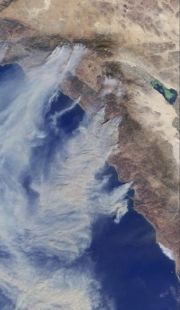
Forest fires, heat and heatwaves – the increasingly extreme effects of climate change – present enormous challenges for man and nature. These developments preoccupy Miroslav Srnka intensively and move him deeply. The decisive impetus for his new Cello Concerto “Smoke” ultimately came from satellite images from NASA which show our planet in its totality. The huge plumes of smoke from forest fires can clearly be seen – powerful images which document and warn in equal measure.
For Miroslav Srnka the musical idea forms the starting point, not just a political angle thought up later: “My approach of creating links to the themes in my works is always orientated inwards: I search for structural consequences in the sound, and not first and foremost for political messages. I am extremely interested in the opportunities provided by musical structures. With the latest computer-aided possibilities, these once again seem to be almost unlimited.”
Smoke, which forms the basis of the piece, has an extremely interesting structural effects, for it makes the wind and its dynamics visible. The smoke caused by forest fires is at the same time the fascinating power of nature and also a flowing spatial form which moves organically in the course of time and plays with curves, forms, density and speed. All these paramters and possibilities stand at the heart of Miroslav Srnka’s music. “Smoke can emerge as a fine, artistically curved line which rises from the first spark. It can, however, also accumulate into a dense mass, engulfing everything, which spreads inexorably in all directions. Repeating movement patterns feature in its flows, which constantly generate similar forms without repeating these exactly”, says the composer.
In “Smoke” the solo cello embodies the smoke, veiling the luminous sound of the orchestra. In the way that smoke can presage a first small flame which engulfs the earlier plume of smoke, a huge cloud of smoke can also engulf the whole fire. They both engulf each other, in both the long and short-term. In this way the solo instrument initiates the orchestral sound and at the same time increasingly loses itself in the course of the whole piece in its sonorous density and luminosity.
The piece passes through three different cycles of rise and decay, reflecting these unique characteristics of smoke in sound. The structures themselves metamorphose in such an extreme and far-reaching way, that they finally become mere sounds, just as smoke simply dissipates into the background colour. This cycle of smoke and flames now seems to last almost uninterrupted for the forseeable future.
The premiere in Japan takes place on the occasion of the 100th anniversary of the NHK Symphony Orchestra, followed by further performances including in Prague with the Czech Philharmonic, conducted by Jakub Hrůša.
Miroslav Srnka / Tessa Singer
(from [t]akte 2/2026)
(translation: Elizabeth Robinson)