



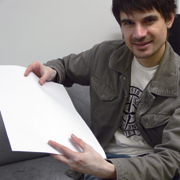
[10.10.2012] In his work The Absent, composed for the Rainy Days Festival in Luxembourg, Russian composer Vadim Karassikov develops a subtle game with perception by means of extreme reduction.
There exists, as Vadim Karassikov recounts, the story of a European tourist in Japan, who is allowed to visit a meditation room in a Buddhist monastery not normally open to the public. She felt the energy of this empty space with such an unbearable physical force that she had to leave the room immediately. The strong presence of the empty consciousness robbed her of everything by which she normally protected herself from every self-disclosure. Suddenly, she examined her own spirit, which she had always resisted doing for decades. The familiar world of the many wonderful things around her, any form of distraction – everyday family life, conversations, television, radio, telephone, internet, sport ... – all of a sudden seemed to her like a powerful drug against her own consciousness. Most people – as Vadim Karassikov sums it up – constantly use such “drugs” in order to dull their self-awareness; on the other hand, monks in Zen monasteries do not attempt to run away from this problem, but observe it very closely for a while – until it disappears by itself.
There is no need for horror vacui, the fear of empty space (used, incidentally, in art history as a term for a completely over-detailed style of painting), when listening to Vadim Karassikov’s new piece The Absent, despite its extreme reduction of tonal happenings. At the “almost silent sound and space installation”, which receives its premiere on 25 November 2012 at the Rainy Days Festival in the Philharmonie Luxembourg, the subtle game with perception begins as soon as you hand in your coat at the cloakroom before making your way to your seat on the stage of the Grand Auditorium, surrounded by different screens, whilst the musicians of the Ensemble intercontemporain are dotted around in the audience and backstage area. Should you, however, wonder how best to respond when you suddenly find yourself in a space with a completely unfamiliar musical situation, then Vadim Karassikov, smiling, recommends an ancient Indian maxim: “Whatever happens to you, do not try to grasp it and make something of it, but let it come and let it go.” That is, incidentally, for him the essence of what can still be learnt from the Zen disciple John cage today: “More energy, more interest and more strength develop in order to allow things to simply happen. The will to improve the means which bring one closer to one’s own nature. Otherwise he would never have sought out Daisetsu Suzuki and never composed what he did compose.”
However, even more clearly than Cage, the late work of Mozart has left its traces in The Absent – there is a short quotation from the beginning of the string quartet KV 589 in a prominent place. For Karassikov, these bars contain a concentration of the feeling of total vulnerability, transitoriness and helplessness on the one hand, with boundless beauty on the other: “The beginning of the allegro is the strongest and most brilliant musical and artistic expression of this – the greatest happiness and the greatest sorrow which life holds, both at the same time. You do not have to defend yourself, there is nothing against which you ought to defend yourself. Everything is simply incredible, abiding beauty. That is the essential. Mozarts last words. “I cannot change it. But see how beautiful it is.”
Bernhard Günther
(translation: Elizabeth Robinson – from [t]akte 2/2012)