

Logo: takte
Das Bärenreiter Magazin
  • Portrait
  • Music Theatre
  • Orchestra
  • Contemp. Music
  • Complete Ed.
  • Publications
  • Calendar
  • Contact

Deutsch wechsle zu deutsch

Agostino Steffani’s operatic masterpiece “Niobe”

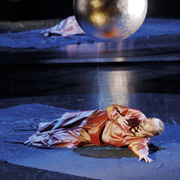
„Niobe“ at Schwetzinger Festival 2008

Agostino Steffani
Niobe, Regina di Tebe. Dramma per musica in tre atti. Libretto von Luigi Orlandi
Edited by Wolfgang Berthold and Thomas Krümpelmann

23., 25., 27., 29.9, 1., 3.10.2010 London (Royal Opera House Covent Garden), 3. und 5.12.2010 Grand  Théâtre de Luxembourg, Balthasar-Neumann-Ensemble, conductor: Thomas Hengelbrock, stage director: Lukas Hemleb (Produktion der Schwetzinger Festspiele 2008)

Cast: Niobe (soprano), Anfione (soprano), Manto (soprano), Creonte (alto), Tiberino (tenor/baritone), Clearte (alto), Nerea (mezzosoprano), Tiresia (baritone), Poliferno (baritone)

Orchestra: 2,2/Pifferi,0,0 - 0,4,0,0 - timp - strings - Basso continuo 
Publisher: Edition Balthasar Neumann via Alkor-Edition

An Italian at German courts: Agostino Steffani. The composer bridged the gap between Italian and French taste and in the process created a quite distinct idiom, full of powerful expression. This is shown at its best in his opera “Niobe, Regina di Tebe”.

Niobe, Regina di Tebe composed in 1688 is Steffani's last opera for the court of Munich and at the same time his most important. Already the Libretto knows how to effectively draw attention to the incredible vehemence of Niobe's tragedy. The story is about the Queen of Thebes. Cursed by the gods for her pride with the death of her children the pain of loss makes her turn into stone. Amphion, her husband, cannot take the grief and kills himself. Thus the town is freed from tyranny and regains freedom.

Although Steffani was deeply embedded in the music language of his native country, he developed an individual style of composing by picking up elements of the French style, which was perceivable also in an especially big and colourful instrumentation. Amphion for instance, mythical inventor of the lyre and of harmony, is thus introduced in his first scene with an instrumental effort, not heard in a long time in Italian opera.

This aria alludes to the harmony of spheres in Platon's Politeiea and Steffani strikingly succeeds in painting an evident picture of this harmony with all resources of musical art. The death scenes of Niobe and Amphion are marked by a hard realism: Every emotion between pain and desperation is expressed in the most sophisticated way. Not only the death of the two main characters on open stage has made Steffani's opera one of the most extraordinary operas of the 17th century. The work is confined on a rather small but equally weighted number of characters. Just like in an intimate play this allows an exceptionally distinct character drawing, which makes this opera fervently interesting for the modern opera stage. 

Thomas Krümpelmann
from [t]akte 2/2010

<- Back to: Music Theatre

Deutsch wechsle zu deutsch

Music theatre

Typically French. The “Faust” works by Berlioz and Gounod
A crazy idea. Bohuslav Martinů’s comic opera “Alexandre bis”
“Leonore”: Beethoven’s unknown “Fidelio”. The new edition of the 1805 version
Can this turn out well? Love between enemies in Rameau’s “Les Fêtes de Ramire”
Orpheus and Euridice. The drama about the power of singing, about love and death
Counterpoint and theatrical instinct. Four new editions of works by Conti
Full of dramatic and psychological intensity Jean-Baptiste Lully’s opera “Psyché”
Gluck’s ballet music to “L’Île de Merlin”
Deadly Encounters. Miroslav Srnka’s new opera “Voice Killer”
Of wood and angels of lizards. Beat Furrer’s opera “DAS GROSSE FEUER” for Zurich
Joseph Haydn’s operas offer something for every taste
Celestial twin love. The first version of Rameau’s opera “Castor et Pollux”
“Simply brilliant!” Marco Comin edits the music of Francesco Bartolomeo Conti
Egyptian flair in Fontainebleau. Rameau’s opera “La Naissance d’Osiris”
“Carmen” under the magnifying glass. The potential of different versions
ImprintData Protection