



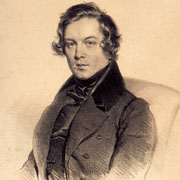
Manfred Trojahn has composed "Cinque sogni per Eusebius" for the Düsseldorf Symphony Orchestra under conductor Andrey Boreyko, which was premiered in the Tonhalle Düsseldorf together with an orchestration of Schumann’s "Träumerei". The composition for the Schumann anniversary year picks up on the characteristic short form of the Romantic period. Trojahn’s herbstmusik has been premiered by the Niedersächsisches Staatsorchester conducted by Wolfgang Bozic in Hannover.
Cinque sogni per Eusebius is a composition for Robert Schumann: musical dreams, as it were, which Manfred Trojahn addresses to Eusebius, that is, to one of the literary figures in which Schumann portrayed himself. “Dream is a romantic theme”, says Manfred Trojahn, “which doesn’t mean that I could identify myself with the rapturous-idealistic posture of the early Schumann. With Schumann I cannot find the irony that I feel in the late romanticism of a Richard Strauss or Thomas Mann, which is closer to my rather disturbed and distanced view of the world. However, I have sympathy for Schumann’s outlook and his E.T.A. Hoffmann-esque searching.”
Therefore it’s a memorial to the composer who last worked in Düsseldorf, but without explicit musical references. And yet, in the five short orchestral pieces which Trojahn has composed with Cinque sogni per Eusebius, a principle lives on which Schumann invented: that of the sharply-contoured musical short form which he featured in his conception of a “characteristic music” in precise form. The first of the pieces, Andante, comes to life in the combination of the smallest, heterogenous elements and short tempo developments at measured walking pace, whilst the second, Vivace, is characterised by a major break: out of a violent development of the tempo, the action suddenly changes completely into a Moderato cantabile. The third piece is an expansively structured Adagio with great intensification, whilst the fourth remains delicate throughout, with a melodic development: movement which at the end leads to a steadily moving. In the last movement, in a swirling three-eight time, larger opposites are again juxtaposed.
The orchestra is scored for double woodwind, therefore corresponding with the early 19th century orchestra, but with instrumental doublings (not common then) such as contrabass trombone and alto flute. With these, Trojahn produces a characteristic idiom, such as when, in the opening part of the Vivace “the moving motifs are overhung by a dark shading of low-pitched alternating instruments, which produce a quite soft carpet of sound in the second part, which is rhythmically very divided.” Rapid signal-like calls from the four horns create a mood full of quotations which has many pre-echoes, a “brief vocabulary” which evokes a natural landscape rich in allusions.
Marie Luise Maintz
(from [t]akte 2/2010]