



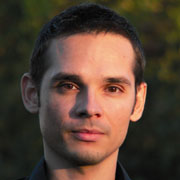
For Miroslav Srnka, born in 1975 in Prague, the Czech tradition is extremely important, in the sense of a musical mother tongue which has shaped him, alongside the great masters of modern music of the twentieth century such as Boulez, Stockhausen, Ligeti, Messiaen and others. He lists Dvořák and Janáček in particular as such models, who introduced new qualities to music – characteristics like sound contrasts, colour, gesture and dynamic progression. „He special thing about Dvořák is the quality of being able to express the most profound things about a human being without bringing his or her existence into question.” In his compositions, Miroslav Srnka integrates an awareness of tradition and an attitude which Hans-Klaus Jungheinrich describes as “utopian-keen to experiment and orientated to the future”: „Srnka sees responsibility for the musical material… as an impetus for the increased differentiation of expression and notation.”
Les Adieux
”Les Adieux” is a piece dating from 2004, which I have now revised and is which is very important for me. It goes back to an invitation to a summer academy with the Ensemble Intercontemporain. At that time I was working on the sources for Dvorak’s ”Stabat Mater”. It originated as his first major work in an extreme situation, where he had lost his first three children and was once again childless. This situation moved me greatly and I wrote Les Adieux, the three parts of which contain a farewell for each child.”
”Les Adieux” has a double point of reference; the title and musical material allude to Beethoven’s Sonata Op. 81a, quasi as Srnka’s ”Kindertotenlieder” [songs on the deaths of children] for Dvořák. The opening cadence is built into the work as a hidden quotation, as a triple ”Adieu” (Farewell). ”The principle of Beethoven’s sonata is that he plays with the resolutions of the cadence in order to continually open up new formal possibilities for the piece. I have attempted to take this problem further, whereby the cadence is only present cryptically. I attempt to find post-Beethovenian solutions, as perhaps Dvorak might have developed in different phases.”
In scoring and sound, a layer of piano and bell instruments is very much present; these help to create clear accentuation, that is to say a non-amorphous sound picture. The compositional principle is a specific handling of the instrumentation, namely involving the entire forces in the examination of the material – that is, not reserving a musical gesture for one instrument, rather illuminating it in many ways in all the parts. Material is consciously detached from colour. ”Les Adieux” was composed in 2004 for a masterclass with the Ensemble Intercontemporain under the direction of Peter Rundel, and received its premiere in November 2007 given by the Ensemble Modern and Matthias Pintscher. It is dedicated to Susanna Mälkki and Matthias Pintscher.
Pohou vlnou
In the piano quintet ”Pouhou vlnou”, Srnka has now written a veritable piece of chamber music-making for five equal instruments which ”systematically explore the most varied combinations of scoring for piano quintet – solos, duos, trios, etc. in order, after several short-lived attempts towards a conclusion, to combine definitively into a ’piano quintet’”. Even though pared down to the essence, the structures here are complex in order to allow the simultaneity of layers of material, which allow a free combining of parts.
Marie Luise Maintz
(translation: Elizabeth Robinson)
(from takte 2/2007 and 1/2008)