



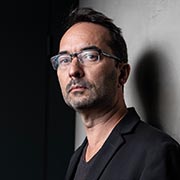
The French composer Yann Robin, born in 1974, is one of those composers who work with cycles. At the outset, a piece might not have been conceived as part of a series; it can, however, be the first one of such and inspire research into the problems of form, of sound, of material.
It is often an encounter with a musician which sets things in motion. For twenty years Yann Robin has collaborated with the Ensemble intercontemporain and its soloists, with pieces and cycles conceived for and with them. Each exchange, each search leads to the discovery of instrumental potential and unimagined possibilities, and to pushing back the limits of tessituras. Of playing with sounds and using those which have recently been abandoned. Opening up the field of options in the instrumental material in order to enrich the orchestral material.
Robin transfers his “trouvailles” from a single instrument to an ensemble and electronics and then combines them in works on a larger scale.
The results of this work can be heard over the years: in “Chaostika” for percussion and electronics with Gilles Durot; in “Art of Metal I” for contrabass clarinet and ensemble, “Art of Metal II” with electronics, followed by “Art of Metal III” with contrabass clarinet, electronics and ensemble with Alain Billard.
This work was successful, and thus Robin continued it with Nicolas Crosse and his double bass, leading to a new cycle: “Symétriades” for double bass and electronics, “Asymétriades” for double bass and ensemble, “Symétriades-Extension” for double bass, electronics and video, “Myst” for solo double bass, “Triades” for double bass, ensemble and electronics.
Other cycles are also worth mentioning, including those with cello, trumpet and horn. And in Robin’s most recent concertos, the double “concertos I et II”, another formal process can be discerned, a fuller sound construction in which soloist(s) in front of, or within the ensemble create new depths and perspectives.
Alongside his explorations in instrumental music, Yann Robin also writes for vocal forces. With his monodrama “Le Papillon noir” for an actress-singer, mixed vocal ensemble, instrumental ensemble and electronics, he began to explore new ways of thinking about the voice. Solo voices, choral parts, spoken, sung, chanted and scraped notes as well as non-European singing techniques offer quite new approaches. Robin manipulates not only the sounds, but also the texts.
These different approaches led to the idea of a monumental composition in which everything was to be combined. A first orchestral work “Monumenta I” was premiered in 2013.
The symphony orchestra, with its grandiose architecture and enormous sound potential, made the “monumental” project possible. This sound factory, which Robin likes to divide in an extreme fashion, inspired him to “Monumenta II”, with the addition of a chorus, vocal soloists, organ and two pianos. Here, too, use is made of the various researches undertaken in recent years: piano Études, the matrix for two solo pianos in the great “Requiem Aeternam – Monumenta II”, “5 Etudes sacrées” for six mixed voices a cappella setting the Latin texts of the Requiem Mass, etc.
Everything requires a matrix, everything is a matrix, everything will become a matrix.
What will follow this magnificent work? Yann Robin has a Concerto grosso in mind, a new creation which brings all these soloists together. And why not an opera?
Valérie Alric
(from [t]akte 1/2024 – translation: Elizabeth Robinson)