



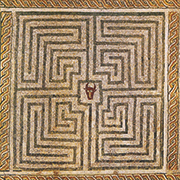
A confusing plot with a happy ending – that’s Baroque opera, that’s Handel. And it’s the same with “Arianna in Creta”. The Halle Handel Edition of the work offers a whole range of possibilities for the stage.
Arianna in Creta was the last opera which Handel wrote for the Second Academy. The rival enterprise, the Opera of the Nobility, performed Arianna in Nasso (libretto by Paolo Rolli) on 29 December 1733 at the Lincoln’s Inn Fields Theatre, conducted by Nicola Porpora. The first performance of Handel’s opera took place on 26 January 1734 in the King’s Theatre Haymarket.
He had written the role of Teseo for his new castrato Giovanni Carestini, whom he had heard in Rome in 1729. However, Carestini only arrived in London in autumn 1733, after Handel had completed the composition. Carestini’s voice had become lower, so that Handel had to transpose almost all the arias in his part downwards. As well as this, the star demanded more arias. This resulted in extensive alterations to the original version. Carestini was given seven arias and two duets, and in exchange the role of Alceste was reduced by one aria to four. Particular high points of the opera are the showpiece aria “Qual leon” with horns (Act II, Scene IV), composed for Margherita Durastanti, and the simile aria “Son qual stanco pellegrino” (II, XIII) with its marvellous interplay of voice and violoncello solo, written for Carlo Scalzi and the cellist Francisco Caporale.
In the 1733/34 season Arianna was the most frequently-performed work with sixteen performances. The libretto, by an unknown poet, is based on at least two adaptations (1721 and 1729), which derived from Pietro Pariati’s libretto to Teseo in Creta (1715).
Athens was an enemy of King Minos of Crete. The Athenians first killed Androgeos, the son of Minos, then their ally Archeus, Prince of Thebes, abducted the new-born daughter of Minos and brought her up as his daughter under the name Arianna.
Consequently Crete waged war on the Athenians, whose army was completely wiped out. Minos made peace on the condition that every seven years, Athens must send a sacrifice of seven young men who were to die in the games in honour of Androgeos, and seven maidens who were to be thrown to the Minotaur. This contract is to continue until a young man overcame the Minotaur, found the way through the labyrinth and overthrew the general Tauride. Arianna is held as hostage by Minos.
The opera begins with the arrival of the victims under the leadership of Teseo, who wants to win Arianna by fulfilling the conditions to end the contract. The maiden Carilda falls in love with Teseo, but she has long been loved by Alceste and as well as this, is sought-after straight after her arrival by Tauride. Arianna does not want Teseo to fight, and reproaches him for his lack of love. Alceste draws the lot for the first victim – on it is Carilda’s name. He too cannot dissuade Teseo from battle. Arianna learns how Teseo can gain victory and helps him, although she thinks he is unfaithful to her and loves Carilda. Tauride attempts to blackmail Carilda: if she will not become his wife, he will dishonour her. With Alceste’s help she escapes from him. Minos chooses Arianna as a replacement victim. Teseo kills the Minotaur, finds his way out of the labyrinth with Arianna’s thread and subjugates Tauride. Athens is freed from the sacrifice, and Teseo asks for Arianna’s hand. In the process he reveals to Minos that Arianna is his daughter. Carilda begins to discover a love for Alceste. The opera concludes with a happy ending.
The scholarly-critical edition of Arianna in Creta in the Halle Handel Edition was published in 2012 (edited by Reinhold Kubik).
Annette Landgraf
(from [t]akte 1/2018)