



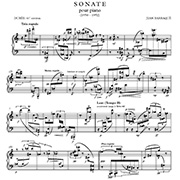
As the first work of serialism in the 1950s Jean Barraqué’s „Sonate pour piano“ combines the new idiom with the idea of the grand form. Heribert Henrich’s edition is a truly pioneering piece of work. For the very first time, the musical text of a piece of serial music has been edited based on a critical evaluation of the primary sources and is now made available to performers.
Jean Barraqué’s Sonate pour piano, which has in fact already been recorded on LP and CD nine times, is the first work which the composer completed and acknowledged. It was mainly written in 1950–52. It is of historical significance because it represents the first attempt ever to combine the then new idiom of integral serialism with the idea of a large through-composed form. Whereas Barraqué’s one-movement work is about 40 minutes in duration, contemporary serial works, whether by Boulez, Stockhausen or Nono, were comparatively short or comprise several movements.
It was clear from early on that the first published edition by Aldo Bruzzichelli in 1966 contained many errors, which present a considerable obstacle to any pianist studying the piece. This was due both to the unprofessional presentation of the music engraving, but also to fundamental difficulties of notation resulting from the way the work was conceived.
The new edition represents pioneering work, for here for the very first time an attempt has been made to produce a critical edition of a musical text from the heyday of serial music. This has required not only a meticulously precise examination of the sources, but also considerable analytical efforts, as authoritative editorial decisions can often only be made by recourse to the complex constructional basis of the work. In the process the editor has not only had to tread in the delicate challenging area of predetermined order and compositional decisions, but he has also been confronted by the phenomenon of the interaction of different structural levels, occasionally even contradicting each other. This has often made it necessary to weigh up different solution models against each other, and in the case of contradictory material constellations, to find well-founded solutions. This philologically time-consuming process explains, alongside the sheer number of editorial problems hidden in the work, why the text section and Critical Commentary clearly exceed the musical text in extent.
The edition was created over a period of eight years. A provisional stage of the edition, in which the aspect of practicability was to foremost, was performed by Nicolas Hodges in 2012 at Ultraschall Berlin. For publication as a printed edition, this version was subsequently revised according to the recent editorial-philological criteria and expanded with a detailed account of this in the Commentary. All available sources – including the sketches, fragmentary and complete manuscripts, and various proofs – were consulted, with the last autograph of the work serving as the primary source for the editorial decisions.
Heribert Henrich
(from [t]akte 1/2019 – translation: Elizabeth Robinson)